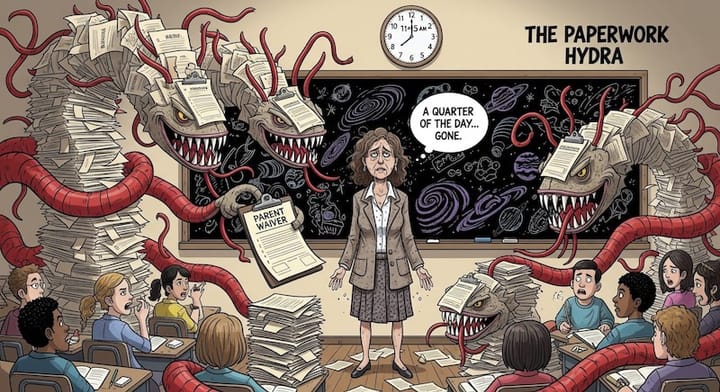
Down in Ohio, a dear reader of ours—we’ll call her Mrs. Gable—goes to work every morning to perform a simple, honest craft.
She is a teacher.
Her goal is to take a lump of unformed clay, the mind of a child, and shape it into something useful, maybe even beautiful. She has a few simple tools: a book, a piece of chalk, and her own voice.
But her workshop has been invaded. Not by Vandals or Goths, but by a far more destructive horde: the Jargon Merchants. These are the ed-tech gurus, the corporate consultants, the pedagogical innovators with freshly minted PhDs in Uselessness.
They arrive in sensible sedans, armed with PowerPoint presentations and a dead language of buzzwords. They have sold their snake oil to the administrators, and now the whole rickety enterprise runs on it. Mrs. Gable, the last honest craftsman, is left trying to build a cabinet with rotten wood and a set of inscrutable blueprints.
Decrypting the Memos
Consider the modern school directive. It is a document written not to be understood, but to be 'leveraged,' 'actualized,' and 'unpacked.'
The goal is not clarity, but the illusion of profound, cutting-edge thought. It is the lingua franca of the incompetent, designed to conceal the simple fact that no one in charge has any idea what they are doing.
Last month, Mrs. Gable received a mandatory email from the district office. It ordered her to “implement a cross-functional, asynchronous ideation matrix to synergize student-centric learning outcomes.”
She spent two days staring at it, wondering if it was a coded message from a foreign power. Finally, she asked a younger colleague, who sighed and translated: “They want us to let the kids work in groups.”
Good heavens. A society that requires a whole new vocabulary to describe children talking to each other is a society in terminal decline.
The Cargo Cult of Technology
Of course, no modern folly is complete without the quasi-religious worship of technology. The school district, which pleads poverty when asked for new history books, recently found $100,000 for an AI-powered “Personalized Learning Platform.” The administrators hailed it as a revolution.
The revolution was short-lived. The AI’s first “personalized” lesson for one of Mrs. Gable’s brightest students was to have her count to ten. For a boy struggling with long division, it recommended a documentary on quantum physics.
After a week of this nonsense, Mrs. Gable quietly unplugged the machine. In its place, she passed out worksheets she had photocopied at her own expense. The students learned more in twenty minutes with paper and pencil than they had in a week with the blinking, humming god of progress. But the box was expensive, so it must be good… right?
Speaking a Foreign Tongue
The rot, you see, has trickled down. The jargon has escaped the asylum of the administrative offices and infected the general population. Parents now arrive at conferences spouting the same corporate nonsense they are force-fed at their own make-work jobs.
Last week, a father sat across from Mrs. Gable and asked to see the “Q3 KPIs” for his eight-year-old son. He wanted to “touch base” on the boy’s “socialization deliverables” and worried about his “personal brand synergy.” Mrs. Gable, bless her heart, had to gently explain that her job was to teach the boy to read, not to manage his nascent career as a future junior vice president of something-or-other. The man looked at her as if she were a blacksmith at a tech conference, a relic from a forgotten age.
The Simple Power of Chalk and a Voice
And so, the teacher’s only refuge is in the ancient, proven tools of the trade. Last Tuesday, the school’s multi-million-dollar “Smart” network, which controls everything from the lights to the digital whiteboards, crashed spectacularly. The principal was in a tizzy, running through the halls as if the Visigoths were at the gates.
In her classroom, Mrs. Gable was unfazed. The expensive tablet on her desk was a dead brick. So she put it aside, picked up a simple piece of chalk, and turned to the old slate blackboard. “Alright, class,” she said, “Forget the video. Today, I’m going to show you how the Roman Empire fell.”
From memory, she drew a map of ancient Europe, her voice weaving a story of hubris, debt, and decline. The children were utterly silent, captivated not by a flashing screen, but by an act of pure, unadorned teaching. They were witnessing a real skill, a real craft, a real human connection.
This is the absurd state of our world. The education system has become a Tower of Babel, a cacophony of experts and consultants and managers all shouting gibberish at each other. The teacher is the only one left speaking a common tongue.
While the jargon merchants sell their potions and the administrators build their bureaucratic empires, she quietly closes her classroom door.
And there, in that small sanctuary, she performs the simple, absurd, and profoundly noble act of teaching a child something true.