We got a letter the other day from a dear reader, a history teacher from somewhere deep in the Ohio suburbs.
Let’s call him Mr. Smith.
He’s been in the trenches for 20 years, and from the sound of it, the war is not going well.
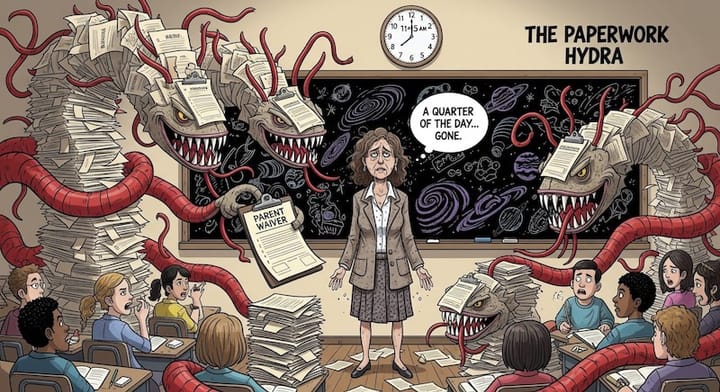
Mr. Smith tells us his job description has undergone a quiet, seismic shift. He is no longer an educator. He is a de-escalation specialist. The classroom is not a forum for the robust exchange of ideas; it’s a therapeutic safe space, a legal minefield, and a daycare for overgrown toddlers with anxiety disorders. His primary duty is not to impart the hard-won wisdom of the ages, but to manage feelings, coddle fragile egos, and, above all, avoid a call from the principal… or worse, a lawyer.
He is, by his own account, the last sane man in the asylum.
The Customer Is Always Right
The trouble began, as it so often does, when the old virtues were replaced by new business models. The student ceased to be a pupil, an empty vessel to be filled with knowledge, and became a customer. And the parent, who was once a partner in the noble work of child-rearing, morphed into a litigious supervisor, armed with an MBA in grievance and a PhD in what they read on a parenting blog.
Last semester, Mr. Smith found himself in the principal’s office, staring at a formal reprimand being placed in his permanent file. His crime? He had given a student, let’s call him Brayden, a B+.
The parent’s complaint, a five-page, single-spaced document, accused Mr. Smith of causing their son “incalculable emotional distress.” A B+, the document argued, was not a grade but an “act of pedagogical violence.” The family did not pay their property taxes, they fumed, for their child to be told he was merely “above average.” Mr. Smith was ordered to attend a three-day sensitivity seminar on “Affirmational Grading Methodologies.” He tells us he spent most of it doodling pictures of the Fall of Rome.
The Ministry of Feelings
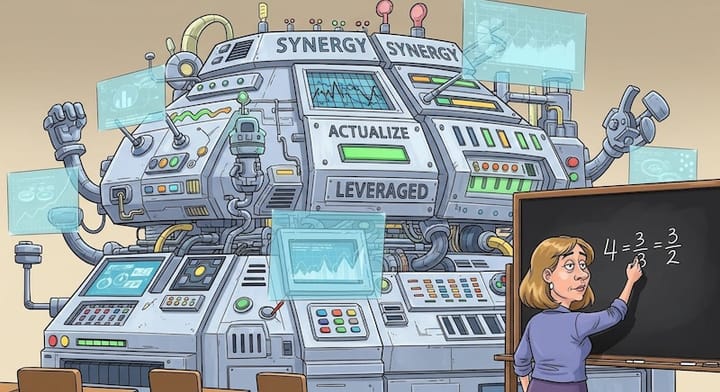
You see, in the modern school, facts are an inconvenience. Math, history, science… these are all secondary to the grand, overarching mission of Social-Emotional Learning (SEL). The administration has become a Ministry of Feelings, and its chief export is nonsense.
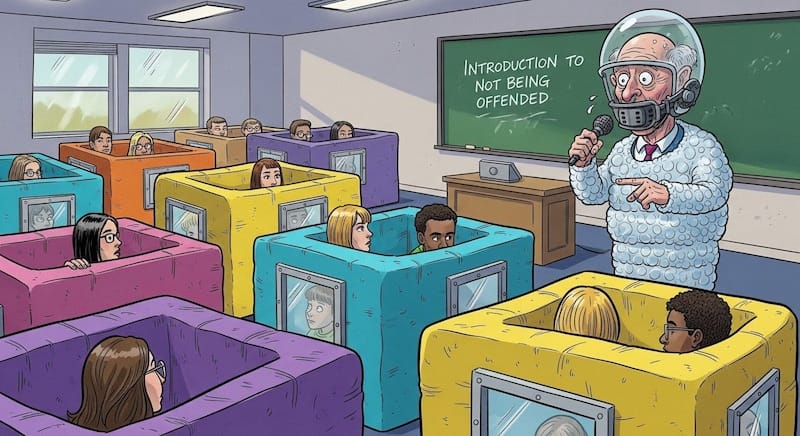
Two weeks ago, the school’s fire drill was brought to a screeching halt. The alarm bell, a sound designed for the express purpose of saving lives, had apparently “triggered” a student’s anxiety. The principal, a man whose spine appears to be on backorder, immediately canceled the drill. A school-wide memo followed, announcing that all future emergency drills were postponed until they could source a “less confrontational auditory signal.” They were looking into gentle wind chimes.
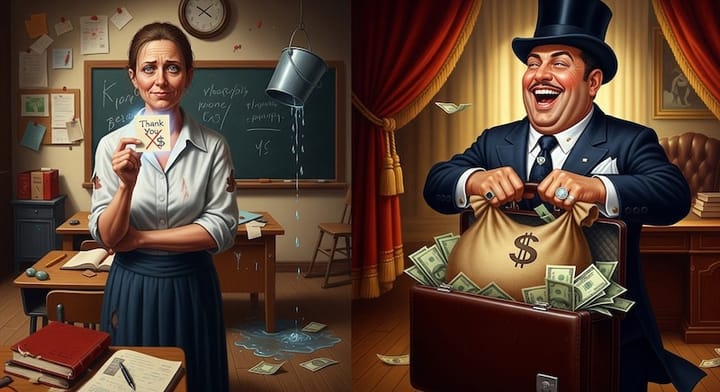
Meanwhile, Mr. Smith’s request for new history textbooks—the current ones end somewhere around the Clinton administration—was denied due to “budgetary constraints.” Who needs to learn about the past when you can spend that money figuring out how to make an emergency less, well, urgent?
‘My Little Angel Would Never…’
The most baffling front in this war, however, is the parental denial. An entire generation of parents seems pathologically incapable of believing their child is anything but a future Nobel laureate. The teacher is always the problem.
Mr. Smith recently caught a student, phone in his lap, cheating on a final exam. The evidence was ironclad—he had the whole thing on the classroom security camera. He called a meeting with the parents, expecting, at a minimum, a shred of shame.
Instead, the father watched the video, nodded thoughtfully, and delivered his verdict. “He wasn’t cheating,” the man explained, with the smug certainty of the truly ignorant. “He was engaging in collaborative peer-to-peer knowledge verification. I read about it on LinkedIn. Frankly, you should be encouraging this kind of teamwork.”
What do you say to that? Where does reason even begin?
Clandestine Education
And so, Mr. Smith has become a dissident. An intellectual rebel. After the official curriculum on the Civil War was replaced by a six-week unit on “Mindful Conflict Resolution and Historical Harm,” he took matters into his own hands.
He keeps a few promising students after class. He closes the door, pulls the blinds, and takes out an old, dog-eared map. For 15 glorious, illicit minutes, he tells them about Pickett’s Charge, about the sunken road at Antietam, about the terrible, beautiful, and necessary lessons of history. It’s a small act of defiance, like a samizdat publisher printing forbidden truths in a Soviet basement. It is the only thing that keeps him going.
This is the state of our union, dear reader. The teacher stands as the last adult in a room full of children—some of whom are on the payroll. They are soldiers on a battlefield of absurdity, armed with a red pen they’re no longer supposed to use and a reservoir of common sense that is now considered a hate crime.
They are not winning. How could they? But their heroism is not in the victory, but in the struggle. It is in showing up each day, ready to face the wind chimes and the therapeutic jargon anew, and in secretly whispering the truths that are no longer allowed to be spoken aloud.
Bless their hearts.
They’re all we’ve got left.