Folks around Piqua, Ohio, will tell you that Beatrice Evans didn’t get into teaching to get rich, which is a bit like saying a fella doesn’t take up flagpole sitting to enjoy the spacious legroom.
She got into it for the same reason a master carpenter picks up a piece of seasoned oak: to shape something raw and promising into something sturdy and beautiful. Her material just happens to be the wandering minds of 13-year-olds.
Her plan for today was simple—to use the vast, cold beauty of the cosmos to light a fire in a few of them. But in the modern American schoolhouse, a good plan is just a list of things waiting to be mugged in a dark alley by this century’s most prolific villain.
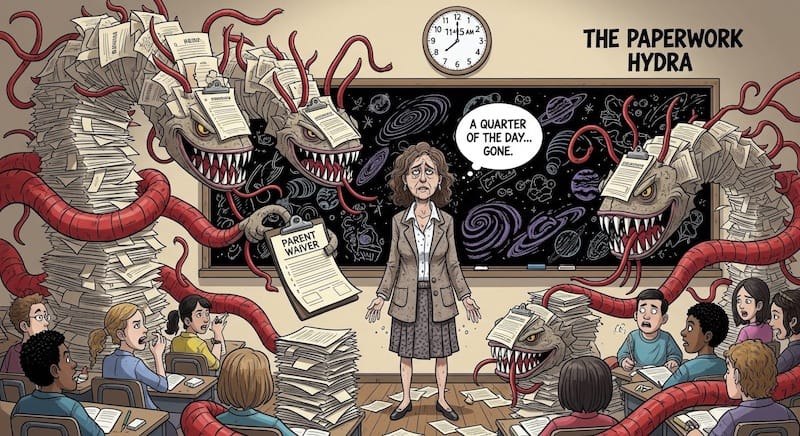
We’ll call it The Hydra, that many-headed beast of administrative compliance. Let’s follow Bea’s 480-minute contract day and keep a running tally. This isn’t a story about education; it’s the minute-by-minute account of a grand theft.
The opening bell of this heist rings at 7:45 AM. Beatrice arrives, a thermos of coffee in one hand and a box of petri dishes in the other, ready for a complex astronomy lab.
Her first priority isn't cosmic, though; it's terrestrial. A boy named Leo, sharp as a tack but twice as shy, bombed a quiz yesterday. She’s carved out a precious fifteen minutes to talk with him, one-on-one, to mend his confidence before the day swallows him whole.
But at 7:48 AM, The Hydra strikes. An email, flagged URGENT in a blood-red font from the principal’s office, announces that the “Student Learning Objective Pre-Assessment Data” must be uploaded to the “State Educator Effectiveness Portal” before 9:00 AM.
This isn’t teaching. It’s a 45-minute digital chain gang, transcribing meaningless numbers into a spreadsheet that will be read by no one but which proves, to someone somewhere, that “accountability” is happening. The lab prep evaporates. The window to speak with Leo slams shut.
Later, at 9:20 AM, during a lesson on nebulae, Bea notices Chloe, a bright girl, staring into the middle distance with the kind of hollow gaze that has nothing to do with galaxies. A teacher’s gut screams, check in.
But The Hydra’s second head hisses. She must keep one eye on Chloe and the other on the whiteboard, where she’s required to display a minute-by-minute “Instructional Pacing” timeline, just in case an administrator performs a “Learning Walk.” The performance of compliance has murdered the art of connection.-----Then comes the 30-minute “duty-free” lunch, a concept as mythical in education as the unicorn.
Bea’s plan for this sliver of peace, at 12:05 PM, is to call Chloe’s parents.
But at 12:06 PM, the Hydra’s next head demands its tribute. She is ordered to complete a mandatory online “Threat Assessment Level 1” form because a student made a tasteless joke about the cafeteria food.
The form, a masterpiece of bureaucratic paranoia, has 52 questions. It requires her to cross-reference the student’s three-year attendance record with his disciplinary file to determine if a joke about mystery meat constitutes a credible vector of insurrection. It takes 28 minutes.
No call is made to Chloe's parents. No lunch is eaten. A moment for proactive intervention is sacrificed on the altar of reactive paperwork.-----The afternoon offers a fleeting glimpse of what could be. At 1:40 PM, the astronomy lab is finally underway. A group of students, huddled over a microscope viewing meteorite dust, lets out a collective gasp. They’ve seen something unexpected, a flicker of crystalline structure, and they are buzzing with the electric thrill of pure discovery.
This is it. This is the moment—the unscripted, beautiful spark of inquiry that keeps teachers like Bea in the game.
But the magic lasts all of two minutes. At 1:42 PM, a guidance counselor enters with a clipboard. The Hydra demands an immediate sacrifice. Bea must abandon the excited students to fill out a “Recommendation Checklist” for a special high-school program for three students.
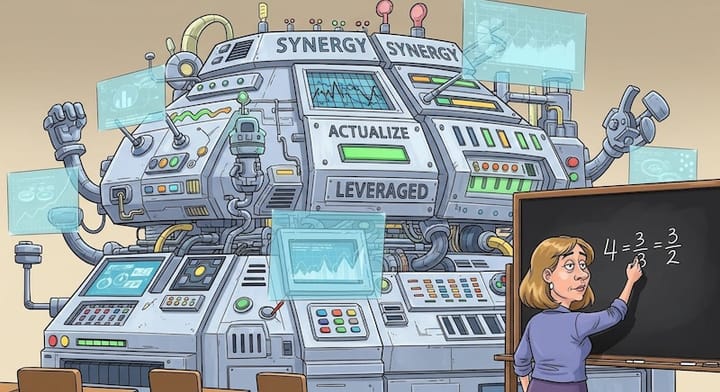
It’s not a letter where she can speak to their character; it’s a bubble sheet, asking her to rate them on a scale of 1 to 5 on buzzwords dreamed up in a corporate retreat, like “Grit” and “Teamwork Synergy.”
By the time she’s done converting human children into data points, the moment is gone. The students are packing up, the spark extinguished by the cold, dead hand of a checklist.-----The 3:15 PM bell rings, signaling the end of the 480-minute workday. Let’s check the ledger. Time spent on direct, human-to-human mentorship and inspiration? You’d be lucky to find 15 minutes.
Time stolen by The Hydra for data entry, compliance documentation, and soul-crushing forms? Over 120 minutes, a full quarter of the day. The heist is complete.
The system didn’t just steal Beatrice Evans’s time. It stole Leo’s chance to regain his footing, Chloe’s opportunity to be heard, and an entire classroom’s brief, brilliant brush with wonder.
And for what, you ask? For a thicker file. For a data point on a chart in a state capital that proves learning is being "effectively assessed." They say a fish rots from the head down, and our education system is proving it one pointless form at a time.