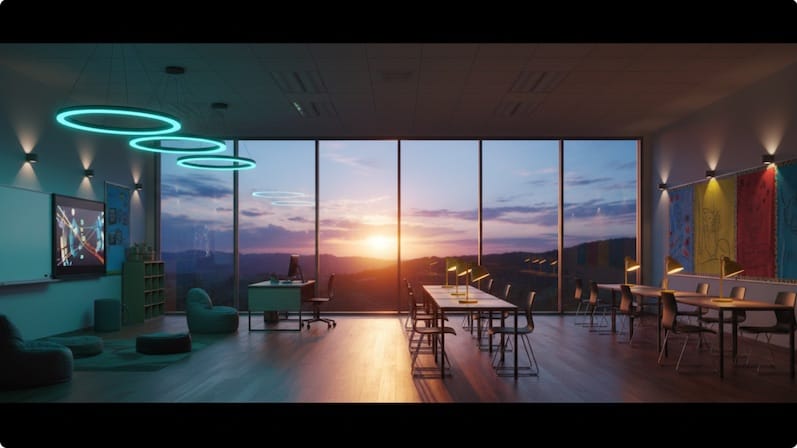
Most people focus on desks, chairs, and technology when thinking about classroom design. But two often overlooked elements have a major impact on how well students learn: lighting and color.
The right combination of lighting and color choices can improve student focus, boost mood, and enhance academic performance in measurable ways.
Research shows that natural light helps students stay alert and perform better on tests. Cool colors like blue and green promote calm and concentration.
Warm colors like yellow spark creativity and energy. Even small changes to lighting levels or wall colors can shift how students feel and behave throughout the school day.
Key Takeaways
- Natural and adjustable lighting systems help regulate student alertness and reduce eye strain throughout the day
- Cool colors promote focus and calm while warm colors encourage creativity and active learning
- Combining the right lighting with strategic color choices creates classroom environments that support different learning activities
The Critical Role of Lighting and Color in Classroom Design
Lighting and color choices in classroom design directly affect how students learn, feel, and perform throughout the school day. These design elements work together to create environments that either support or hinder the educational process.
Why Lighting and Color Matter for Learning
Classroom lighting serves purposes beyond basic visibility. Natural and artificial light sources influence how students perceive their surroundings and engage with learning materials.
Studies show that proper lighting reduces eye strain and fatigue during reading and writing tasks. Color temperature plays an important role in educational spaces.
Different color temperatures affect the mood and energy levels of students in measurable ways. Warm lighting creates relaxed environments, while cooler lighting with higher color temperatures promotes alertness and focus.
Lighting represents 14% of total building energy use, making efficient design choices important for both educational outcomes and operational costs. Reflective surfaces and strategic window placement maximize natural daylight, reducing the need for artificial lighting throughout the day.
Influence on Student Performance and Well-Being
Adequate lighting directly impacts test scores and attendance rates in schools. Students in well-lit classrooms demonstrate improved concentration and academic performance compared to those in poorly lit spaces.
The visual comfort provided by appropriate lighting helps students maintain focus during extended learning periods. Specific color schemes affect student mood, energy, and engagement levels.
The right combination of colors and lighting creates inclusive learning environments that accommodate diverse teaching methods. These design choices support both collaborative activities and individual study.
Poor lighting conditions lead to headaches, eye strain, and decreased motivation among students. Proper classroom lighting design prioritizes student health by ensuring adequate illuminance levels and appropriate contrast ratios for different tasks and activities.
Impact on Cognitive Processes
Lighting affects cognitive function through both visual and non-visual pathways in the human eye. Non-visual responses include the regulation of circadian rhythms, which play a role in alertness and mental clarity during school hours.
The timing and type of light exposure influence these biological processes. Dynamic lighting that changes throughout the day can improve cognitive performance.
Higher illuminance levels and appropriate color temperatures enhance task performance and information processing. These factors help students maintain attention during complex learning activities.
The duration and intensity of light exposure shape how well students process and retain information. Lighting design that aligns with biological needs supports better cognitive outcomes in educational settings.
Fundamentals of Classroom Lighting
Good classroom lighting requires balancing multiple light sources, following design standards that support student needs, and eliminating common problems like glare and flicker.
These basics create a learning environment where students can focus and perform their best.
Balancing Natural and Artificial Light
Natural light provides the best foundation for classroom lighting. Students exposed to daylight show improved performance and attention throughout the day.
Windows and skylights help regulate circadian rhythms, which keeps students alert and reduces fatigue. Artificial light fills the gaps where natural light falls short.
LED systems work well because they can adjust to different needs. Cool-toned light increases alertness for morning classes or tasks requiring focus.
Warm-toned light creates a relaxed atmosphere for quiet reading or group discussions. The key is coordination between both sources.
Classrooms need artificial lighting that complements available daylight rather than competing with it. Light sensors can automatically dim artificial lights when natural light is strong.
This maintains consistent brightness levels without wasting energy.
Classroom Lighting Design Principles
Effective lighting design starts with understanding the activities that take place in the space. Different tasks require different light levels.
General classroom work needs about 300-500 lux, while detailed tasks like reading small print require 500-750 lux.
Key design considerations include:
- Light distribution - Even coverage across all work surfaces prevents dark spots
- Color temperature - 4000-5000K supports focus and reduces eye strain
- Flexibility - Adjustable systems adapt to various teaching methods
- Fixture placement - Overhead lights should be positioned to avoid shadows on desks
Layered lighting approaches work best. This means combining ambient light for general visibility with task lighting for specific activities.
Control systems let teachers adjust brightness based on the lesson, whether it's a lecture, group work, or video presentation.
Managing Glare, Shadows, and Flicker
Glare creates discomfort and makes it hard for students to see clearly. Direct glare comes from bright light sources in the field of vision.
Reflected glare bounces off surfaces like whiteboards or computer screens. Both types reduce concentration and cause eye strain.
Proper fixture selection prevents most glare problems. Fixtures with diffusers or louvers spread light evenly without creating bright spots.
Positioning lights parallel to windows rather than perpendicular reduces conflicts between natural and artificial sources. Shadows interfere with reading and writing when they fall across work surfaces.
Multiple light sources from different angles minimize shadow formation. Shadows under desks or in corners make spaces feel smaller and less welcoming.
Flicker from old fluorescent lights causes headaches and fatigue. Modern LED systems eliminate this issue when properly installed.
High-quality drivers and compatible dimming systems prevent the imperceptible flicker that still affects some students even when not consciously noticed.
Natural Light: Benefits and Challenges
Natural light plays a vital role in creating effective learning environments, offering measurable benefits for student well-being and academic performance while presenting practical implementation challenges.
Research shows that classroom design incorporating natural light can account for up to 25% of a student's progress over a school year.
Optimizing Daylight in Learning Spaces
Natural light creates an inviting atmosphere that supports both comfort and concentration in classrooms. Students exposed to adequate daylight show improved information retention and cognitive function compared to those in artificially lit spaces.
The combination of natural and artificial light produces the best results for student attention and academic performance. This balanced approach allows educators to maintain consistent lighting levels throughout varying weather conditions and times of day.
Key optimization strategies include:
- Positioning desks and learning areas near windows to maximize daylight exposure
- Using adjustable blinds or shades to control glare without blocking natural light completely
- Selecting light-colored interior finishes that reflect and distribute sunlight throughout the space
- Installing skylights in interior areas that cannot access wall-mounted windows
Geographic location and seasonal changes affect the amount of available sunlight. Schools must account for these variations when planning lighting strategies to ensure consistent illumination year-round.
Architectural Strategies for Maximizing Natural Light
Window placement determines how effectively natural light reaches learning spaces. Windows positioned on multiple walls create better light distribution than single-wall installations, reducing dark corners and shadows.
Light shelves installed above eye level redirect sunlight deeper into classrooms while minimizing direct glare on student work surfaces. These horizontal surfaces reflect light onto ceilings, which then disperses it evenly throughout the room.
Effective architectural elements include:
| Element | Function |
|---|---|
| Large windows | Increase overall light penetration |
| Skylights | Illuminate interior spaces without exterior walls |
| Glass doors | Allow light transfer between adjacent rooms |
| Clerestory windows | Provide high-level lighting without compromising privacy |
Retrofitting older buildings presents cost challenges that many schools cannot easily address within existing budgets. New construction offers more flexibility for incorporating natural light features from the design phase.
Strategic landscaping helps control direct sunlight exposure while maintaining adequate illumination levels. Trees and exterior overhangs can reduce excessive heat and glare during peak sunlight hours.
Health and Mood Impacts
Natural light directly influences student well-being by regulating circadian rhythms that control sleep patterns and alertness. Students in daylit classrooms experience better sleep quality, which translates to improved focus during school hours.
Exposure to natural light increases serotonin production, a neurotransmitter that enhances mood and creates a positive emotional state. This biological response reduces feelings of fatigue and lethargy common in windowless or poorly lit spaces.
Natural light lowers cortisol levels, the hormone associated with stress. Students in naturally lit environments show decreased anxiety and improved emotional resilience, particularly during high-pressure academic periods.
Mental health benefits include:
- Reduced symptoms of depression and seasonal affective disorder
- Increased energy and motivation levels
- Better emotional regulation and classroom behavior
- Enhanced overall mental well-being
Classrooms with ample daylight help students feel more comfortable and connected to their surroundings, creating conditions where both learning and personal development can thrive.
Artificial Lighting Solutions for Modern Classrooms
Artificial lighting systems in classrooms have evolved significantly, with LED technology leading the transformation through improved energy efficiency and controllable light quality that directly affects student performance and comfort.
Types of Artificial Lighting
Classrooms typically use three main types of artificial lighting systems. Fluorescent tubes have been the traditional choice for decades due to their low cost and decent energy efficiency.
These fixtures spread light evenly across large spaces but can flicker and hum over time. Incandescent bulbs produce warm light but waste significant energy as heat.
Most schools have phased out these fixtures due to high operating costs. LED fixtures have become the preferred option for modern classroom installations.
They last 50,000 hours or more compared to 15,000 hours for fluorescent lights.
Key Lighting Type Comparison:
| Type | Lifespan | Energy Use | Color Quality |
|---|---|---|---|
| Fluorescent | 15,000 hrs | Medium | Limited |
| Incandescent | 1,000 hrs | High | Warm only |
| LED | 50,000+ hrs | Low | Adjustable |
Ceiling-mounted panels provide general illumination, while task lights help students with close-up work. Accent lighting can highlight specific classroom areas.
The Rise of LED Lighting
LED lighting has transformed classroom environments through better control and lower costs. Schools can adjust LED systems to match different activities throughout the day.
These fixtures produce less heat than older technologies, making classrooms more comfortable. The energy savings are substantial.
LED systems use 60-70% less electricity than fluorescent alternatives. A typical school district can save thousands of dollars annually after switching to LED fixtures.
Modern LED systems offer tunable white light. Teachers can shift the color temperature from warm (3000K) to cool (6500K) based on learning tasks.
Research shows that higher color temperatures around 6500K improve student attention and academic performance. LED fixtures also eliminate the flicker problems associated with fluorescent lighting.
This reduces eye strain during extended reading or computer work.
Controlling Light Quality and Intensity
Smart lighting controls let teachers adjust brightness and color temperature for different activities. Dimmer switches provide simple intensity control, while advanced systems connect to classroom schedules.
Light sensors measure natural daylight entering the room. The system automatically adjusts artificial light levels to maintain consistent illumination.
This combination of natural and artificial light creates optimal conditions for student focus. Color temperature matters for specific tasks.
Cooler light (5000-6500K) supports concentration during math or reading activities. Warmer light (3000-4000K) works better for creative projects or group discussions.
Lighting Controls:
- Manual dimmers for teacher adjustment
- Automated scheduling systems
- Daylight sensors for natural light integration
- Zone controls for different classroom areas
Some schools are testing colored lighting systems. Green and blue lights may boost creativity, while specific colors affect student mood and energy levels.
Color Temperature and Its Effects on Learning
Color temperature, measured in Kelvin (K), influences how students think, focus, and perform in classroom settings. Research shows that different color temperatures activate distinct cognitive responses and affect comfort levels during learning activities.
Understanding Color Temperature
Color temperature describes the warmth or coolness of light sources. Lower color temperatures around 3000K produce warm, yellowish light similar to traditional incandescent bulbs.
Higher color temperatures between 5000K and 7000K create cool, bluish-white light that resembles daylight. The human brain responds differently to these light qualities.
Warm light triggers relaxation responses in the body. Cool light activates alertness pathways in the brain.
Most classroom lighting falls between 3000K and 6500K. A study of primary school students aged 10-13 found that 4000K produced the best cognitive performance results.
Students at this color temperature showed the lowest brain wave activity associated with mental effort and reported the highest comfort levels.
Impacts on Alertness and Focus
Color temperature directly affects student alertness and attention span. Cool light at higher color temperatures increases cortical excitation in the brain.
This heightened brain activity supports focus during demanding cognitive tasks. Students exposed to 6500K lighting demonstrated improved reading comprehension and mathematical problem-solving abilities.
The cool light enhanced morning cortisol responses, which contributed to better work motivation and cognitive mobilization. Brain wave measurements reveal specific patterns under different color temperatures.
Students working under 4000K lighting showed reduced mental fatigue compared to those under 7000K conditions. The moderate color temperature balanced alertness with comfort.
Gender differences emerge in color temperature responses. Female students performed better under cooler light conditions above 5000K.
Male students showed stronger cognitive performance in warmer light environments between 3000K and 4000K.
Color Temperature Recommendations for Different Activities
Different classroom activities benefit from specific color temperature ranges:
| Activity Type | Recommended Color Temperature | Reason |
|---|---|---|
| Reading and detailed work | 4000K - 5000K | Supports visual clarity without causing fatigue |
| Creative activities | 3000K - 4000K | Promotes relaxed thinking and idea generation |
| Testing and focused tasks | 5000K - 6000K | Enhances alertness and concentration |
| Group discussions | 3500K - 4500K | Creates comfortable environment for interaction |
Classrooms should maintain illumination at 500 lux when adjusting color temperature. This brightness level paired with 4000K creates optimal conditions for general learning activities.
Schools using dynamically adjustable lighting systems between 3500K and 6500K reported improvements across multiple performance measures. Morning classes benefit from cooler color temperatures above 5000K to help students reach full alertness.
Afternoon sessions work better with slightly warmer temperatures around 4000K to maintain comfort as natural fatigue increases.
The Psychological and Cognitive Impact of Color
Color influences student attention, memory retention, and emotional states in educational spaces. Research shows that specific colors affect cognitive processes differently, with females and males responding distinctly to various color schemes in classroom environments.
Color Psychology in Education
Different colors trigger specific psychological responses that directly affect learning outcomes. Red increases alertness and energy but can elevate stress levels during extended exposure.
Blue creates a calming atmosphere that helps students focus on complex tasks and promotes relaxation during intense study sessions. Yellow stimulates mental activity and encourages creativity.
It works well in brainstorming areas or creative learning spaces. Green reduces eye strain and creates a balanced environment that supports sustained concentration.
Studies with university students reveal that color significantly affects female students' attention levels more than male students. The saturation and hue of colors matter just as much as the color choice itself.
Highly saturated colors produce stronger reactions, while muted tones create subtle effects on mood and cognitive performance.
Dynamic Color and Smart Lighting
Modern classrooms can adapt color schemes based on learning activities and time of day. Smart lighting systems allow teachers to adjust both color temperature and wall illumination to match specific educational tasks.
Warmer colors work better for collaborative activities and group discussions. Cooler colors support independent work and test-taking scenarios.
This flexibility addresses different cognitive needs throughout the school day. Digital tools and adjustable LED systems make color changes simple and cost-effective.
Teachers can program preset color configurations for reading time, creative projects, or quiet study periods. These systems support student well-being by reducing visual fatigue and maintaining engagement across different activities.
Integrating Color into Classroom Design
Effective classroom design balances color choices with lighting conditions and spatial geometry. Color appears different depending on how light falls on surfaces, so designers must test colors under actual classroom lighting.
Key integration strategies include:
- Using neutral base colors on large surfaces
- Adding accent colors in specific learning zones
- Considering texture alongside color choices
- Testing colors under both natural and artificial light
The size and shape of a classroom affects how students perceive colors. Smaller rooms need lighter colors to avoid feeling cramped, while larger spaces can handle deeper tones.
Architects and interior designers should segment their approach by considering gender-based differences in color response when planning learning environments.
Frequently Asked Questions
What research reveals about the effect of classroom lighting on student performance?
Studies show that natural light has the strongest positive impact on student performance. Research by Hathaway in 1995 found that students in classrooms with more daylight showed improved test scores and better attendance rates.
A multi-level analysis published in Building and Environment demonstrated that proper lighting design contributed to measurable academic gains. Natural light helps regulate students' circadian rhythms.
This regulation improves alertness during school hours and reduces fatigue throughout the day. LED lighting serves as an effective alternative when natural light is limited.
Cooler light temperatures increase alertness and work well for morning classes or tasks requiring high concentration. Warmer light temperatures support relaxation and quiet activities.
Research indicates that proper lighting reduces eye strain. When students experience less physical discomfort, they maintain focus for longer periods.
Which colors are scientifically proven to enhance concentration and learning in classroom settings?
Blue and green are the most effective colors for promoting sustained concentration. Studies in color psychology show that blue creates a tranquil environment conducive to deep focus.
Green, associated with nature, produces a calming effect that supports mental clarity. These cool tones work best in study zones and quiet reading areas.
They help students maintain attention during tasks requiring extended focus periods. Yellow enhances cognitive functions such as memory retention.
Research links this warm tone to optimism and improved information processing. However, it should be used thoughtfully rather than covering entire walls.
Neutral colors like soft grays and beiges create balance in learning spaces. They provide a soothing backdrop that prevents sensory overload while allowing accent colors to stimulate without overwhelming students.
How does classroom design, including lighting and color, affect student engagement?
The combination of lighting and color creates distinct learning zones that support different activities. Active learning areas benefit from warm colors paired with bright natural or artificial light.
This setup encourages dynamic thinking and collaboration among students. Quiet zones require soft blues and greens combined with dimmable or natural light.
These spaces promote calm and help students focus without distractions during independent work. Flexible lighting systems allow educators to adjust brightness based on classroom activities.
Brighter light supports hands-on tasks and lessons requiring high concentration. Dimmer light creates a relaxed atmosphere for reading or group discussions.
Research published in Policy Insights from the Behavioral and Brain Sciences found that thoughtfully designed classrooms maximize student achievement. The physical environment shapes how students interact with learning materials and participate in class activities.
Can specific colors in the classroom environment impact student mood and behavior?
Red increases physical energy and attention levels but must be used carefully. Too much red can heighten stress and create anxiety in students.
Small doses of red draw attention to specific elements or energize high-activity areas effectively. Orange stimulates energy and works well in collaboration spaces.
This warm tone supports brainstorming and active discussion when used sparingly. Excessive orange becomes distracting and can reduce focus during individual work.
A study on classroom beautification found that paint colors selected by color experts increased students' feelings of engagement. Both students and teachers reported improved experiences in spaces with thoughtful color choices.
Cool tones like blue and green reduce anxiety and promote calmness. These colors help manage behavior by creating an environment that feels less chaotic and more controlled.
What are the best practices for implementing effective lighting in educational spaces to facilitate learning?
Maximize natural light access through large windows or skylights whenever possible. Natural daylight provides the most benefits for student alertness, mood regulation, and academic performance.
Install adjustable LED lighting systems in spaces where natural light is insufficient. Choose lights that can shift between cooler temperatures for morning classes and warmer temperatures for afternoon activities.
Create different lighting zones for various learning activities. Bright light works best for active learning and detailed tasks.
Softer light supports relaxation and quiet work periods. Avoid harsh fluorescent lighting that creates glare or flickers.
These lighting conditions cause eye strain and headaches that interfere with concentration. LED alternatives provide consistent illumination without these negative effects.
Position lighting to eliminate shadows and dark spots in work areas. Students need even illumination across desks and reading materials to prevent visual fatigue.
In what ways can poor lighting and color choices in classrooms hinder the educational experience?
Insufficient lighting causes eye strain and physical discomfort that distract from learning. Students in poorly lit classrooms experience headaches and fatigue more frequently.
These physical symptoms reduce the amount of time students can maintain focus on academic tasks. Harsh fluorescent lights create an uncomfortable environment that affects mood.
Research in ergonomics shows that poor lighting conditions increase stress levels and decrease overall well-being. Overly stimulating colors overwhelm students and make concentration difficult.
Too much red or bright orange increases anxiety and creates a chaotic feeling in the classroom. Students struggle to calm their minds and settle into focused work.
Lack of color variety creates a dull environment that fails to engage students. Monotone classrooms with only white or gray walls provide no visual interest.
Poor lighting combined with inappropriate colors compounds negative effects. The combination creates barriers to learning that affect both academic performance and emotional well-being.